Completeness and Truth
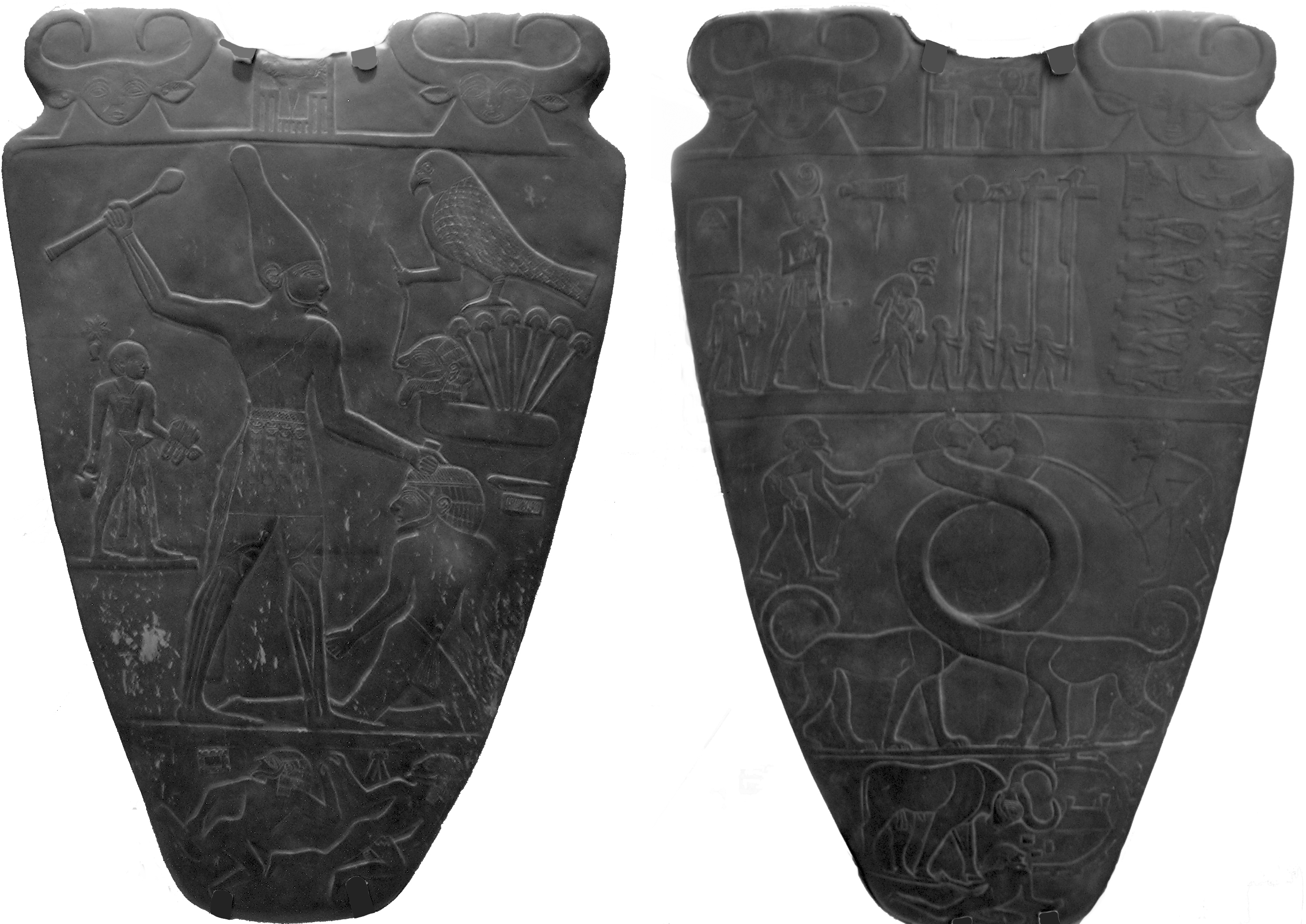 |
| Figure 1 Source Link - The Narmer Palette -- Green Schist, Artist Unknown, c. 2950 BCE |
 |
| Figure 2 Source Link - Judgement of Hunefer Before Osiris -- Painted Papyrus, Artist Unknown, c. 1285 BCE |
QUESTION: How is it possible that what the Egyptians considered "completeness", could be misinterpreted as crude, naïve or unrealistic and how does it affect the “truth” contained in their art?
PART ONE:
SUMMARY: Before I settled on this question, I had been researching for Question #2a about the story of Adam and Eve and the Egyptian's beliefs about knowledge and immortality. Reading analyses of the allegory of the Genesis story (one I am very familiar with) gave me great insight about the interpretation of mythology in general. I then set my sights on Egypt to learn about their beliefs in immortality. I found the mythology fascinating and went through a series of revelations about how the Egyptians viewed the physical and spiritual world and their role in it. After all my reading, I finally understood what this question meant by the word "completeness" and realized that I wanted to answer this question more than the other question. Having the opportunity to immerse myself in the beliefs of ancient Egypt was a great experience.
REASON: The reason this question was asked is to open the mind of the writer to art and cultures that may seem at first glance simplistic or weird. These sorts of prejudices are useless if one wants to interpret and gain something from the art available to them rather than simply lament on the subjective quality of the work.
PURPOSE: The purpose of this question is to force the writer to really look at a piece of art and see its unique qualities and to see beyond stylistic quirks to the heart of an artist's message.
DIRECTION: By answering this question, I feel I have really broke through to a new level of understanding in terms of style and art on a cultural level. I feel much more confident in my ability to see through to the true meaning behind myths and how these concepts relate to the minds of those who create and view them.
IMPRESSIONS: I was not expecting to become so engulfed in the Egyptian side of Question #2a. I was expecting the major benefit of this research to be finally gain an understanding of the Adam and Eve myth and apply this skill to more biblical stories I am familiar with. Learning the Egyptians' beliefs in immortality was sort of wacky but in a fascinating way. Learning more about their religious stories, I saw so much in their art I had never seen before. It felt like my brain had been torn into a million pieces and reassembled as I thought about the meaning and implications of completeness and unity in their art. I have so much respect for Egyptian beliefs knowing what I know now and I am sure they are one of the greatest civilizations to ever put pen to papyrus.
PART TWO:
At the core of any successful design is one basic principle: unity. David Lauer suggests, "Unity is perhaps as close to a rule as art can approach." (Design Basics, David Lauer et al., Cengage Learning, 2011, p. 28) Based on their illustrations, some might consider the ancient Egyptians to have been obsessed with unity and order. Permeating many of their religious myths, for example, is the struggle between chaos and order. The first Egyptian god, Ra, is said to have come into being when he "shaped himself out of the waters of chaos." (Art History Volume 1 3rd ed., Marilyn Stokstad et al., Prentice Hall, 2008, p. 51) With the idea of unity as a driving force in mind, the message in these words and what they reveal about the collective Egyptian mind is powerful. The message here is that the being who preceded all else in existence was the first bringer of unity and integration to the naturally chaotic world.
Next, there is the story of Osiris, the god who first claimed kingship over Egypt. In a fit of jealousy, his brother, the god Seth, hacked Osiris to pieces. Learning of his death, the goddess Isis who was the wife of Osiris recruited her sister and Anubis, the god of embalming and death related activities, to help her reassemble her husband's corpse. After Osiris has been repaired, Isis bears him a son who is called Horus. Horus promptly defeats Seth to reclaim his father's kingship. Osiris, in his own right, becomes the king of the underworld. (Art History Volume 1 3rd ed., Marilyn Stokstad et al., Prentice Hall, 2008, p. 51-52)
The fact that Ra, Osiris, Isis and Horus are all lauded in these stories reveal much about the beliefs of ancient Egyptians. Notable to the story of Horus and Seth is that Horus was considered a force of good and Seth the god of chaos. (Art History Volume 1 4th ed., Marilyn Stokstad et al., Prentice Hall, 2010, p. 51, 61) Here again we see great attention paid to the tug-of-war game between chaos and order, a game which the Egyptians considered order to have won. In this sense, it is easy to understand why the Egyptians survived relatively unchanged for 3000 years, while countless civilizations around them came and went. (http://www.ancient-egypt.org/index.html) In the Egyptian mind, human beings were an island amidst a sea of chaos, fighting the good fight to bring order into a world that will devour anything that can be torn apart.
This complete aversion to chaos can be seen most clearly in the art of these people. Some may look upon works such as the Narmer Palette (figure 1) of the Early Dynastic Period and judge it to be crude. The simplistic representation of forms and ignorance for realistic perspective looks almost childish to a world exposed to the masterpieces of the Renaissance. (Exploring The Life, Myth, and Art of Ancient Egypt, Joann Fletcher, Rosen Publishing Group, 2009, p. 14) Furthermore, there is little emotion injected by the artist and stylistically it is not very different from the Judgment of Hunefer Before Osiris illustration (figure 2) created over a thousand years after the palette. (Art History Volume 1 4th ed., Marilyn Stokstad et al., Prentice Hall, 2010, p. 77) Using the same visual conventions for thousands of years might indicate to some a lack of artistic growth. It might be assumed that the Egyptians did not care to grow, that they were artistic slackers.
These interpretations grossly miss the statement the Egyptians were making with their work. The Egyptian style did not change for so long because their pictures weren't meant to be a display of artistic achievement. In the Common Rider song "Rough Redemption" it is said, "Style communicates the elements of a war." (http://www.softcom.net/users/twolter/lastwaverockers.html) This is an important piece of advice to keep in mind in regard to Egyptian visual art. At their core, these people were historians and storytellers. The war the Egyptians were fighting with their designs was the war between clarity and misunderstanding. Any good storyteller knows that it's all in presentation. No matter how funny the punchline or how hard-hitting the message, if the person or work telling that story fumbles with the details and the order in which they are presented, the story will never land. Not only must a story be presented well, but it also must be concise and appealingly assembled. In other words, "A deft handling of unity is decisive in holding a story together." (Design Basics, David Lauer et al., Cengage Learning, 2011, p. 52) When such important things needed to be said, Egyptians rested on a style so complete in its design that it would be nearly impossible for the message to be corrupted by poor presentation.
The Egyptians seem to have succeeded in this noble goal of clarity above all else. The level of detail seen in each visual piece from this civilization shows that no visual decision stone was left unturned. As one author puts it, "The Egyptians had a marvelous knack for distilling an idea to its purest form in an abstract and powerful way." (http://www.ptahhotep.com/articles/Narmer_palette.html) To illustrate this completeness found in their designs, we turn to an early work, the previously mentioned Narmer Palette. This carving was discovered in 1898 at a location thought to be the Pre-Dynastic capital of Upper Egypt. (http://www.ptahhotep.com/articles/Narmer_palette.html)
In this work, we see that the artist has utilized a number of sophisticated design cues to create a narrative. Commonly thought to show the unification of Egypt and its beginnings as a powerful nation-state, the large form of the King stands as a focal point in the center. (Art History Volume 1 4th ed., Marilyn Stokstad et al., Prentice Hall, 2010, p. 53) Above the figure, a word is written in phonetic hieroglyphs. (Art History Volume 1 4th ed., Marilyn Stokstad et al., Prentice Hall, 2010, p. 52) Here, proximity has been used to link this piece of information with the man below it. (Design Basics, David Lauer et al., Cengage Learning, 2011, p. 34) The viewer now understands that the name of this man is Narmer, the word written in the hieroglyphs. Proximity is also used in numerous items placed with this man that tell the viewer he is a king, such as the white crown of Upper Egypt. (Art History Volume 1 4th ed., Marilyn Stokstad et al., Prentice Hall, 2010, p. 53) Scale is also used in this piece to emphasize not only Narmer's social status, but also his importance within the narrative. (Art History Volume 1 4th ed., Marilyn Stokstad et al., Prentice Hall, 2010, p. 53) Along the same vein, it is noted that the foe kneeling before him is of comparable size to Narmer himself. It appears that the artist utilized scale in this way to make the viewer aware of the main characters in this story of how Narmer tamed Lower Egypt. Creating emphasis through position comes into play in many places in this design as well. (http://www.tersiiska.com/design/principles) We see the god Horus in the form of a falcon sitting above this foe, surrounded by a myriad of symbols associated with Lower Egypt. (Art History Volume 1 4th ed., Marilyn Stokstad et al., Prentice Hall, 2010, p. 53) Looking at this area, one can almost feel the oppressive weight of the god bearing down on the foe. Knowing that Horus is a force of good, this seems to suggest that the message of this narrative is that Upper Egypt's conquer of Lower Egypt was and should be regarded as good. To further support this conclusion, we turn to one more spot where position is key. Above the entire scene, we see the cow-goddess Hathor on either side of Narmer's name. (http://www.ptahhotep.com/articles/Narmer_palette.html) She appears to be making an optimistic facial expression. Hathor was the goddess of love and fertility. (Art History Volume 1 4th ed., Marilyn Stokstad et al., Prentice Hall, 2010, p. 74) Her happy presence above the entire scene seems to indicate that she is protecting the king and condoning his actions.
The amount of symbolic meaning to be found in this piece is phenomenal. The design is not alone in it's narrative richness either; these sort of scenes were commonly found all over Egypt and from every period. Perhaps this style feels simplistic, cluttered, and thoughtless to those who carelessly dismiss Egyptian art, but the level of narrative detail encoded in this composition and others like it proves that the Egyptians were anything but thoughtless or lazy with their visual art. Their ability to cut through the chaotic mess of detail and arrive at the heart of human struggle in its most complete form is incredible. This style of presentation, however simplistic, presents a formidable challenge to anyone attempting to make their name known in the pages of history books when it comes to the utilization of art as a form of communication and storytelling. For now, the Egyptian artistic legacy will live on unmatched as it has for the thousands of years since its creation.

SAM - "At the core of any successful design is one basic principle: unity." Unity is completeness. If we as a society are not "together" then we are apart. A remarkable people indeed and one whose depth of knowledge is much deeper than what is credited to them. "The simplistic representation of forms and ignorance for realistic perspective looks almost childish to a world exposed to the masterpieces of the Renaissance..." So to then does the work of a contemporary abstract artist. I know how hard it is trying to "convince" people who don't know what I know that I am no less an artist because I don't do what they consider is art. I am trying to, "...cut through the chaotic mess of detail and arrive at the heart of..." whatever is in my head. So perhaps, we may also credit them with exploring the abstract but not the abstract of the more modern subjective genre because their abstraction was closer to concrete concepts than someone objectively rendering a a bowl of fruit. This post was your crowning glory and on a scale of 1 to 4 it was an obvious 4. BTW what was the origin of that trinket?
ReplyDelete